The Shallow-Water Advantage: Why Philippine Reef Acoustics Is a Living Laboratory American Universities Cannot Replicate
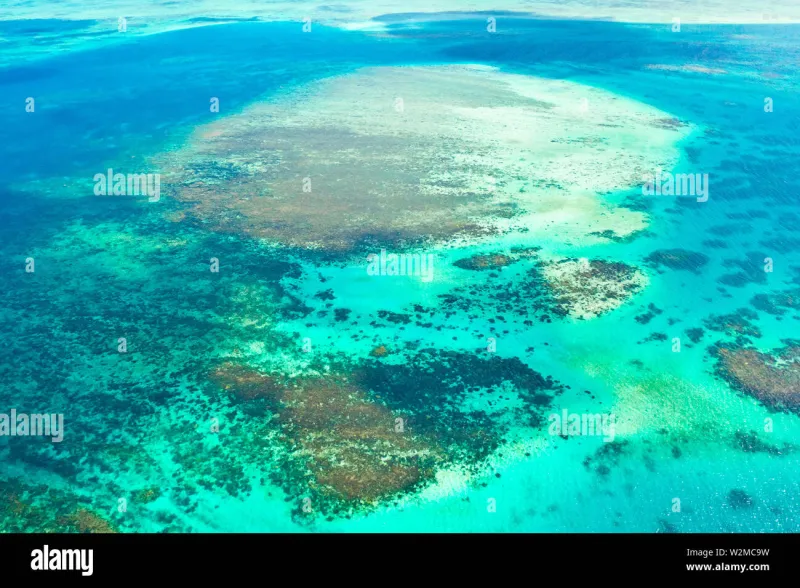
Photo: tropical coral reef shallow ocean water aerial view Philippines, via c8.alamy.com
There is a stubborn assumption in some corners of the American physics community that a conference in Southeast Asia is a scenic add-on — a pleasant epilogue to the serious business of domestic meetings. The research emerging from Philippine coastal laboratories suggests the opposite: the serious business may be happening there first.
A Natural Experiment in Shallow Water
Most American underwater acoustics research is conducted in deep ocean basins or controlled test ranges. The Philippines offers something structurally different: thousands of kilometers of shallow reef environments where sound propagation is governed by bathymetry, coral roughness, biological noise, and thermal layering all at once. These are precisely the conditions that naval, offshore energy, and environmental monitoring applications increasingly need to understand — and that US test facilities struggle to simulate.
Researchers working in the Visayan Sea and around Cebu's surrounding waters have documented how reef topography scatters low-frequency sound in ways that complicate standard propagation models. For a physicist accustomed to the clean geometry of a deep-water channel, the data is messy in the most productive sense. It forces model revisions. It exposes where the textbook approximations break.
Typhoons as Physics Engines
The same geography produces a second research frontier: storm-atmosphere interaction. The western Pacific generates tropical cyclones at a frequency and intensity the Atlantic simply does not match. Filipino and regional research groups have built decades of observational infrastructure around typhoon dynamics — heat flux measurements across the ocean-atmosphere boundary, rapid intensification case studies, and wave-structure coupling in coastal zones.
American hurricane modeling, much of it centered on Gulf Coast and Atlantic institutions, imports assumptions from a different basin. The Philippine record offers an alternative dataset, and increasingly, collaborators who know how to work with it. Sessions at OSAPS 2024 on atmospheric and marine physics are not regional curiosities; they are where the observational frontier sits for anyone studying coupled ocean-atmosphere systems.
What This Means for US-Based Physicists
The practical implication is straightforward. If your research touches acoustics, fluid dynamics, geophysics, or climate-adjacent modeling, the Asia-Pacific literature and the researchers producing it are upstream of work that will eventually reach your subfield through translation and citation lag. Attending OSAPS 2024 shortens that lag to zero.
It also changes the conversation from literature review to partnership. Several Philippine universities maintain active coastal monitoring programs with long observational baselines — assets that would cost a US lab years and significant grant funding to establish. The barrier is not scientific; it is familiarity. Conferences exist to remove that barrier.
Beyond the Vacation Framing
The 'conference as vacation' framing does a disservice to both the host institutions and the visiting researchers. Cebu in 2024 will host working sessions on problems that are geographically impossible to study from Woods Hole, Scripps, or Boulder. The physicists who recognize that early — who treat the trip as field access rather than a detour — will be the ones whose collaborative pipelines run through the region for the next decade.
The laboratory is already built. It is made of coral, warm water, and typhoons. The only question is who shows up to work in it.