Where You Meet Shapes What You Ask: The Hidden Geography of Scientific Discovery
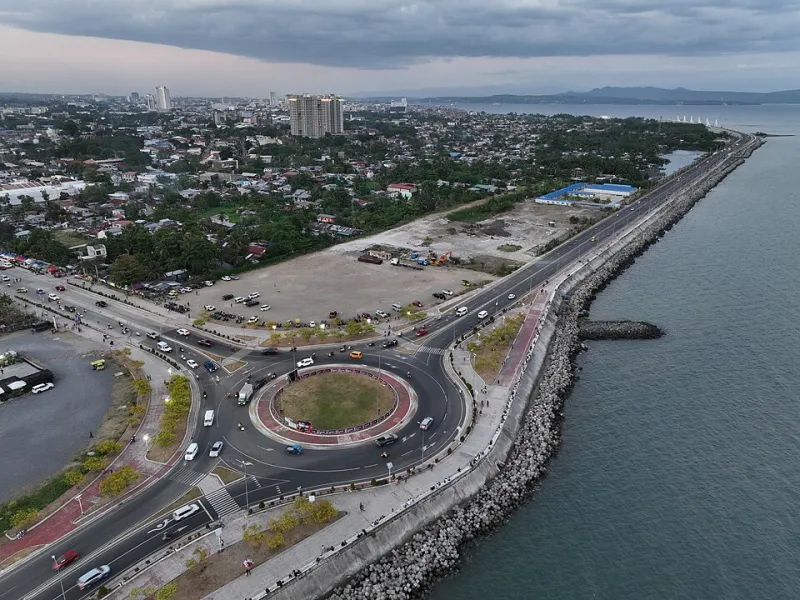
Photo: Patrickroque01, CC BY-SA 4.0, via Wikimedia Commons
The Unspoken Curriculum of Conference Geography
Every major physics conference publishes a formal program—session schedules, keynote speakers, abstract booklets. What no program discloses is the informal curriculum encoded in the city itself. The problems a host region faces, the infrastructure its scientists work within, and the natural phenomena that define its landscape all exert a quiet gravitational pull on what researchers choose to present, discuss, and ultimately pursue.
Cebu, situated at the geographic and maritime crossroads of the central Philippines, brings with it a research environment shaped by seismic activity, tropical oceanography, rapid urban energy demand, and a scientific community that has long operated with fewer institutional resources than its counterparts in North America or Europe. Each of those conditions is, in the language of physics, a boundary constraint—and boundary constraints are precisely where interesting science tends to live.
For OSAPS 2024, that context is not incidental. It is the experiment.
How Location Filters the Research Agenda
Consider the contrast in framing. When a major condensed matter symposium convenes in a large US metropolitan area, the surrounding infrastructure implicitly endorses a certain class of questions: those answerable with abundant computational resources, well-funded laboratory equipment, and supply chains that can deliver specialized components within days. The ambient assumption is abundance.
In Cebu, the ambient assumption is different. Researchers working across the Asia-Pacific have developed rigorous methodologies for doing more with constrained toolkits. That is not a limitation to be apologized for—it is a generative condition. Some of the most durable experimental innovations in modern physics have emerged not from the best-equipped labs but from the most resourcefully designed ones.
Geophysical instrumentation offers a concrete illustration. The Philippine archipelago sits within one of the world's most seismically active zones, intersecting multiple tectonic boundaries. Physicists based in this region have developed sensing and data-interpretation frameworks calibrated to high-noise, high-frequency seismic environments that simply do not exist in the continental United States. American researchers working on similar instrumentation problems—whether for underground dark matter detectors or gravitational wave observatories—encounter those frameworks almost nowhere in their domestic conference circuit. OSAPS 2024 puts those researchers in the same room.
Case Patterns: When Geography Unlocked New Questions
The history of geographically distributed scientific gatherings offers several instructive precedents.
When the International Union of Pure and Applied Physics began rotating major conferences through African and Southeast Asian host cities in the early 2000s, attendees from North American institutions repeatedly reported encountering atmospheric and solar physics research that reframed problems they had considered settled. The reason was straightforward: equatorial observation stations capture solar and ionospheric data at angles and frequencies that mid-latitude observatories cannot replicate. Researchers from those stations had built entire interpretive frameworks around that data. Their American counterparts, confined to mid-latitude reference points, had not known those frameworks existed.
Similarly, materials science conferences hosted in East and Southeast Asia during the past two decades have repeatedly surfaced work on humidity-resistant and high-thermal-variance materials that later became central to US Department of Energy climate resilience funding streams. The connection was not coincidental. Researchers working in tropical and monsoon climates had been solving those materials problems out of practical necessity for years before the problems registered as funding priorities in Washington.
The pattern is consistent: geographically distributed conferences do not merely add new names to a researcher's contact list. They add new categories of questions to a researcher's mental model of what physics is for.
What US Physicists Are Leaving on the Table
American physics networking remains heavily concentrated in a small number of institutional hubs. The American Physical Society's major annual meetings, the various specialty conferences organized by national laboratories, and the informal circuits that connect elite research universities all tend to reinforce a shared set of assumptions about which problems are worth solving and which methodologies are legitimate.
That concentration is not without value—shared frameworks enable rapid collaboration. But it also creates systematic blind spots. Research questions that arise from regional conditions outside the North American experience struggle to gain traction in those venues, not because the science is weak but because the social infrastructure for recognizing its relevance simply isn't there.
OSAPS 2024 in Cebu represents a direct intervention in that dynamic. The conference's location in a mid-sized Philippine city—rather than Manila, Singapore, or Tokyo, which carry their own version of hub-centric assumptions—means that the scientific conversation will be shaped by a genuinely different set of regional priorities. Ocean thermal energy research, tropical atmospheric physics, earthquake-resilient sensor design, and resource-efficient experimental methodology are not peripheral topics at this event. They are structurally central to it.
Recalibrating the Question Before Asking It
For US physicists attending OSAPS 2024, the most productive orientation may be one of deliberate disorientation. Rather than arriving with a fixed agenda and filtering the program for work that maps onto existing research priorities, consider treating the geographic context itself as a primary data source.
What problems do Cebu-based and broader Philippines-based researchers consider urgent? What experimental constraints have they turned into methodological innovations? Where does their work intersect with US research priorities in ways that neither community has yet recognized?
Those questions will not be answered by the keynote addresses alone. They will be answered in the hallways, at the poster sessions, and in the conversations that begin because two researchers are standing in the same subtropical city and trying to make sense of the same physics from very different vantage points.
That, ultimately, is what conference geography provides that no curated program can replicate: the productive friction of encountering science that did not need your assumptions to get done.