From Handshake to Co-Authorship: Turning Conference Encounters Into Enduring Research Alliances
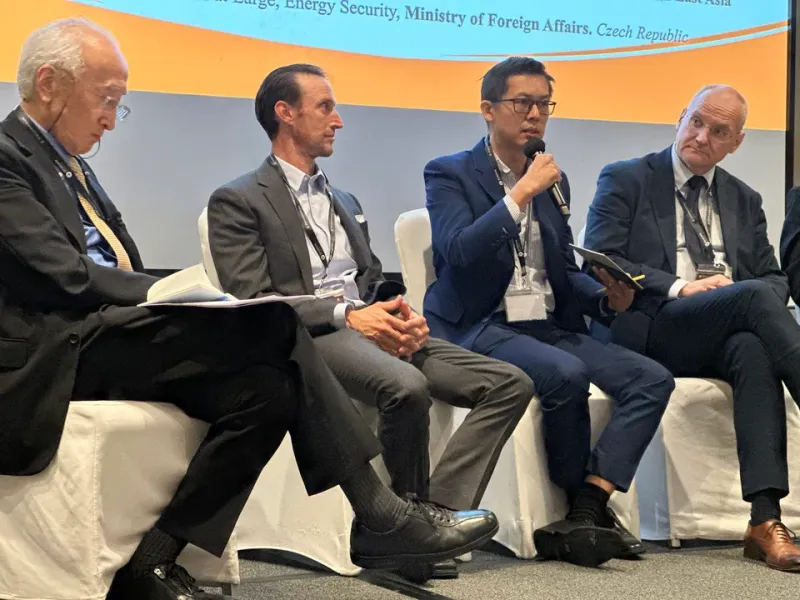
Photo: physicists networking discussion international academic conference Asia, via cassette.sphdigital.com.sg
The Gap Between Meeting and Collaborating
Anyone who has attended a major international physics conference knows the rhythm. You exchange contact information with a researcher from Osaka or Seoul whose poster work intersects neatly with your own. You express genuine mutual interest. You return home with a stack of business cards and the best of intentions—and three months later, nothing has happened.
This is not a failure of ambition. It is a failure of infrastructure. Building a productive research partnership across institutional, national, and cultural lines requires more than goodwill and a shared interest in, say, topological insulators. It requires a deliberate process that begins before the conference opens and extends well past the closing banquet.
OSAPS 2024 in Cebu offers American physicists an unusually concentrated opportunity to build exactly these kinds of relationships. The Asia-Pacific physics community represented here spans some of the most dynamic research environments on the planet. The question is how to convert proximity into partnership.
Prepare Before You Arrive
The most common mistake American researchers make at international conferences is treating preparation as optional. In a domestic conference context, showing up and being present is often sufficient—you share institutional culture, communication norms, and professional shorthand with most attendees. At an international event, that shared baseline largely disappears.
Effective preparation has three components.
Map the research landscape. Before arriving in Cebu, identify ten to fifteen researchers whose work has direct relevance to your own. This means reading recent papers, not just scanning abstracts. Understanding someone's methodological choices, their funding constraints, and their open questions positions you to have a substantive conversation rather than a generic one. Researchers across Asia-Pacific institutions—particularly those at universities where English is a working language but not a first language—respond noticeably better to interlocutors who have clearly done their homework.
Clarify your own research gaps. The most productive collaborations are built on genuine complementarity, not just topical overlap. Before the conference, articulate honestly what your lab cannot currently do—whether that is access to specific fabrication infrastructure, expertise in a particular theoretical framework, or experimental capacity in a domain adjacent to your core work. Knowing your gaps helps you identify partners rather than competitors.
Schedule intentionally. Most major conferences, including OSAPS 2024, publish programs far enough in advance to allow targeted scheduling. Identify not only the sessions you will attend but the specific people you want to speak with during breaks, poster sessions, and social events. Unstructured time at conferences is not wasted time—it is where many of the most important conversations happen—but only if you arrive knowing who you are looking for.
Navigating Cultural and Institutional Differences
American academic culture tends toward directness. Pitching a collaboration idea in the first five minutes of meeting someone is not unusual in a U.S. conference context. Across much of the Asia-Pacific region, that approach can read as presumptuous rather than efficient.
This does not mean that researchers from Japan, South Korea, the Philippines, or Australia are reluctant collaborators—they are, in many cases, actively seeking international partnerships. It means that the relationship-building process often has a different cadence. Initial conversations tend to be more exploratory and less transactional. Expressing genuine curiosity about someone's work, asking follow-up questions, and allowing the professional relationship to develop across multiple interactions within the conference tends to yield better outcomes than leading with a partnership pitch.
Institutional differences matter too. Many Asia-Pacific universities operate under funding structures that make certain types of collaboration—data sharing, joint grant applications, student exchanges—more or less straightforward depending on bilateral agreements between their home country and the United States. Understanding these structural realities before proposing specific arrangements prevents the awkward situation of suggesting something that your prospective partner cannot actually agree to, regardless of personal interest.
Identifying Genuine Research Complementarity
The most durable collaborations are those where each party brings something the other genuinely needs. At OSAPS 2024, American physicists will encounter research groups with strengths that differ from the U.S. academic norm in instructive ways.
Many Asia-Pacific institutions have fabrication and characterization infrastructure that is difficult to access through standard U.S. academic channels. Conversely, American research groups often have strengths in theoretical modeling, computational resources, and certain experimental traditions that are highly valued by Asia-Pacific partners. Identifying where your specific capabilities complement rather than duplicate those of a prospective partner is the analytical core of effective collaboration-building.
During poster and oral sessions, listen for the frustrations as much as the achievements. When a researcher mentions a measurement they could not make, a material system they could not synthesize, or a calculation that exceeded their computational resources, that is often a more useful signal than the polished results they are presenting.
Structuring Follow-Up That Actually Works
The follow-up period—the six to twelve weeks after a conference—is where most potential collaborations die quietly. The solution is to establish concrete next steps before you leave Cebu, not after.
Specifically: agree on a defined, low-stakes first action. This might be sharing a preprint, scheduling a one-hour video call to explore a specific technical question, or co-drafting a one-page concept note for a potential joint project. The key is that the action is specific, time-bounded, and small enough that neither party needs institutional approval to take it.
From that initial action, the pathway to a joint publication or grant proposal becomes navigable in steps. A shared preprint leads to a co-authored paper. A concept note becomes a workshop proposal. A workshop generates the preliminary data that anchors a bilateral grant application.
None of this happens automatically. But at OSAPS 2024, the raw material—brilliant researchers, aligned interests, and genuine institutional momentum toward international collaboration—is present in abundance. The architecture you build around those encounters is what determines whether you leave with a badge or a career-defining partnership.