The Early Signal Advantage: A U.S. Physicist's Field Guide to Spotting Breakthroughs Before They Go Mainstream
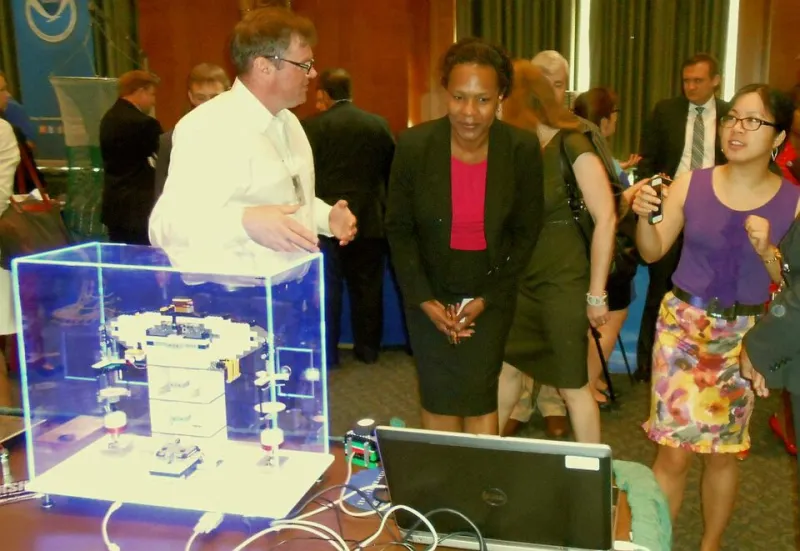
Photo: National Institute of Standards and Technology, Public domain, via Wikimedia Commons
There is a particular frustration familiar to researchers who have spent years following a subfield closely: the moment when a finding that seemed to arrive suddenly in a high-profile journal turns out to have been circulating, in various forms, through conference presentations and regional publications for two or three years beforehand. For physicists whose work depends on staying at the edge of what is known, arriving late to a major development is not merely inconvenient — it can mean duplicated effort, missed funding cycles, and the uncomfortable realization that your competitive position has quietly eroded.
The good news is that this outcome is not inevitable. Breakthroughs rarely materialize without precursors. They leave traces in conference proceedings, regional journals, preprint repositories, and the informal networks that scientists build over years of face-to-face interaction. For U.S.-based physicists, the challenge is that a disproportionate share of those early signals are currently being generated in the Asia-Pacific region — and the dominant information infrastructure of American research is poorly calibrated to detect them.
This is a solvable problem. What follows is a practical framework for building the kind of cross-regional research intelligence that puts you ahead of the curve rather than behind it.
Understand Why Your Current Sources Have a Lag Problem
Before addressing the solution, it is worth being precise about the problem. The major English-language preprint servers and journal databases that most U.S. physicists rely on — arXiv, Physical Review journals, Nature family publications — are excellent resources. They are also, by design, late-stage filters. The work that appears there has typically passed through cycles of refinement, peer review, and editorial selection that compress years of development into a single visible moment.
By the time a paper from a research group in Osaka, Seoul, or Manila reaches Physical Review Letters, that group has likely presented the underlying findings at regional conferences, published preliminary results in journals that don't appear in most U.S. researchers' RSS feeds, and refined the work through collaborations that the final publication may not fully document. The journal article is the conclusion of a story that began much earlier, in venues most American physicists never visit.
Expanding your information diet to include those earlier stages is the core of the early-signal strategy.
Map the Regional Conference Circuit
Conferences are where physics happens before it is published. For the Asia-Pacific region, the conference landscape is both rich and underutilized by U.S. researchers. Events organized under the auspices of the Association of Asia Pacific Physical Societies — including symposia like OSAPS 2024 in Cebu — bring together researchers from across the region whose work spans the full spectrum of contemporary physics, from fundamental theory to applied materials science.
Attending these events serves two distinct intelligence functions. The first is exposure to results that have not yet entered the formal publication pipeline. Poster sessions and contributed talks at regional conferences routinely feature work that is twelve to twenty-four months away from appearing in the journals you already read. The second function is relational: you learn which groups are doing which work, who is collaborating with whom, and where the energy in a given subfield is actually concentrated.
If travel to every relevant conference is impractical — and for most researchers, it will be — the next best approach is to identify a small number of high-value events and attend them consistently. Consistency matters because the relational dimension of conference intelligence compounds over time. Researchers who see you at the same event across multiple years will share information with you that they would not share with a stranger.
Diversify Your Preprint and Journal Monitoring
Beyond conference attendance, systematic monitoring of Asia-Pacific publication sources requires deliberate effort to counteract the default toward English-language, Western-indexed sources.
Several practical steps are worth implementing. First, add regional physics journals to your regular monitoring rotation. Publications like the Journal of the Physical Society of Japan, the Chinese Physics journals, and various national academy proceedings carry work that often predates its appearance in international venues. Many of these journals now publish primarily or entirely in English, which removes the most obvious access barrier.
Second, follow the institutional preprint servers and research portals maintained by major Asia-Pacific physics institutions. Several national laboratories and university consortia in Japan, South Korea, China, and Australia maintain public-facing research databases that are updated more frequently than formal journal submissions. Setting up automated alerts for relevant keywords on these platforms takes less than an hour and can surface significant findings weeks or months before they reach arXiv.
Third, use citation network analysis tools — Semantic Scholar, Connected Papers, and similar platforms — to trace the citation ancestry of papers you already find important. You will often discover that the most-cited predecessors of a breakthrough paper were published in regional venues you had not previously encountered. Following those threads backward and forward simultaneously is one of the most efficient ways to identify emerging clusters of activity.
Build a Cross-Regional Human Network
No automated system fully substitutes for human intelligence. The most reliably early signals in any scientific field travel through personal networks: a colleague mentioning a talk they found unexpectedly impressive, a collaborator forwarding a preprint before it goes public, a casual conversation at a conference dinner that reframes your understanding of where a subfield is heading.
For U.S. physicists, building this kind of network across the Asia-Pacific region requires intentional cultivation. Start with the researchers whose published work you already follow, and make contact in ways that are genuine rather than transactional — commenting substantively on their work, sharing relevant papers, proposing specific conversations around shared interests. Researchers who receive hundreds of generic connection requests are quite good at distinguishing them from genuine intellectual engagement.
Conference attendance is again the most efficient accelerant for this process. A single week at a well-chosen Asia-Pacific symposium can generate more substantive new connections than a year of digital outreach, precisely because the in-person context creates conditions for the kind of extended, exploratory conversation that builds real professional relationships.
Integrate Intelligence-Gathering Into Your Regular Workflow
The strategies described above are only useful if they are practiced consistently rather than sporadically. The researchers who maintain the most effective cross-regional awareness tend to treat it as a workflow discipline rather than an occasional project.
In practical terms, this means allocating a fixed amount of time each week to scanning sources outside your default reading list, maintaining a running document of research groups and individuals whose work you are tracking, and scheduling at least one international conference per year where your primary purpose is intelligence-gathering rather than presentation.
It also means being deliberate about what you do with the signals you collect. An early awareness of a developing research trend is only valuable if it informs your own research planning, grant applications, and collaboration decisions in time to make a difference.
The physics community is genuinely global, and the distribution of breakthrough-level work reflects that reality. American researchers who calibrate their information systems accordingly will not merely avoid being surprised by the next major development — they will be positioned to contribute to it.